Project service sequence

SEER Robotics services that keep fleet acceptance evidence visible

Service planning begins before the first AMR crosses a live aisle. The team defines the operating baseline, load-unit assumptions, WMS/WCS ownership, safe intervention path and the evidence required to resume missions after a fault.

Response objectives depend on installed fleet size, project geography, approved remote access, spare availability and safe site entry. They are documented for the quoted project rather than presented as a universal service guarantee. Peak throughput claims must include SKU mix, order profile, replenishment, buffering and exception recovery assumptions.

Define the service boundary
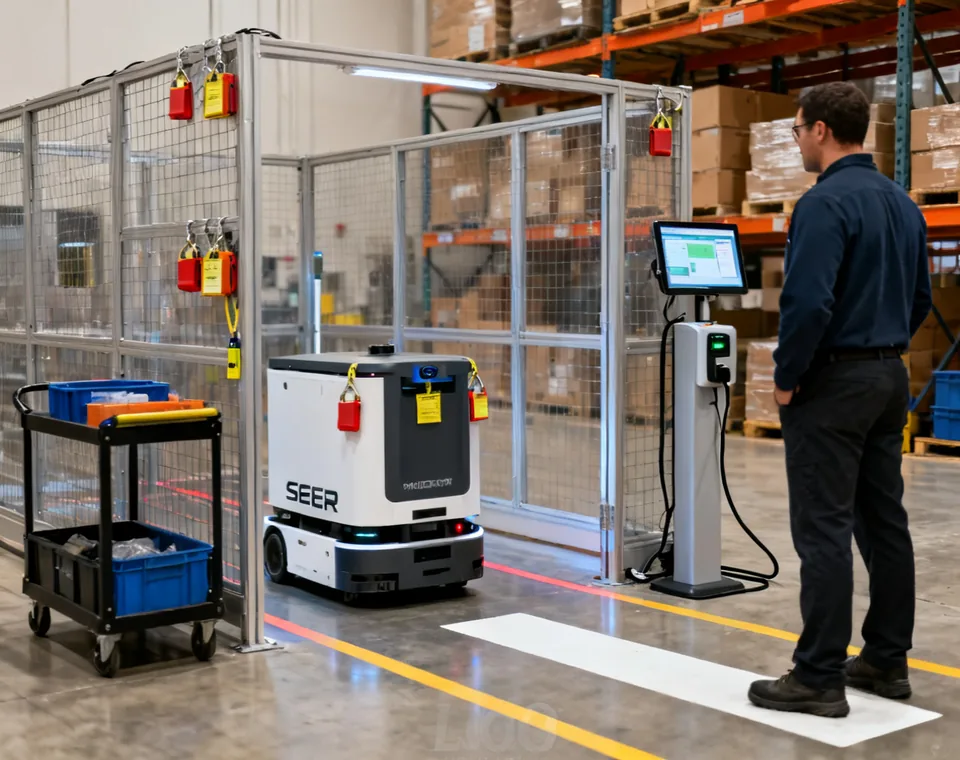
AMR fleet service bay with diagnostics and protected maintenance access
Four bounded workstreams

Each SEER Robotics service activity has an input, owner and closeout record

The overview below is a planning model. Final deliverables, attendance and response windows are confirmed in the commercial scope and responsibility matrix. Fleet density gains can reduce recovery options if fire-protection flexibility and human access paths are incomplete.

01

Flow and fleet review

Check order-line distributions, payload, center of gravity, aisle and fire clearances, duty cycle, charging and the conditions that create backlog at induction or drop points.

  • Input revision register
  • Assumption and sensitivity list
  • Open design decisions
02

Controls boundary

Map WMS, WCS or WES, PLC and fleet-management responsibilities. Define command, acknowledgment, timeout, alarm and restart behavior at every interface that touches mission release. Interface cycle time in seconds belongs in the matrix, not a marketing line.

  • Message and state matrix
  • Interface cycle target in seconds
  • Exception ownership
03

Acceptance preparation

Turn mission-rate and fleet availability targets into scripts with dataset, test duration, instrumentation, exclusions and pass criteria. Separate robot cycles from end-to-end fulfillment results.

  • FAT and SAT scripts
  • Observed-versus-expected log
  • Issue disposition record
04

Operational handover

Prepare alarm triage, isolation, manual fallback, spare strategy and controlled restart steps. Train the roles that authorize access and return the fleet to production.

  • Role-based work instructions
  • Critical-spares basis
  • Restart evidence checklist
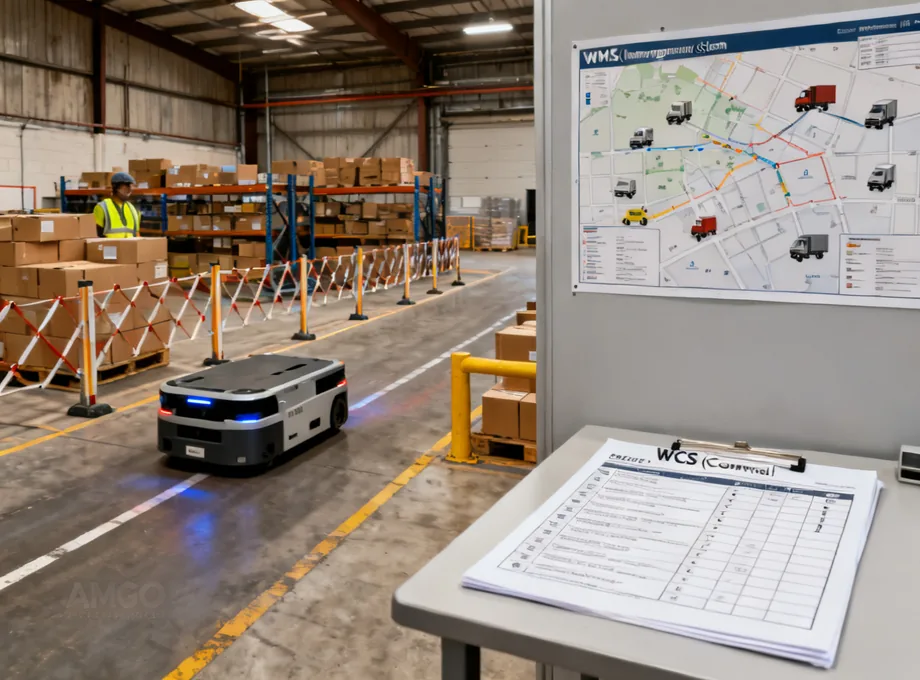
Brownfield AMR commissioning during a controlled warehouse window
Scenario pattern / brownfield cutover

Protect the current shift while the new fleet state is tested

A live building cannot be treated like an empty simulation. The cutover plan identifies the zones that can be isolated, the work permitted during each window and the conditions that return operations to the previous state. Inventory identity and mission ownership are reconciled before robots are released into shared aisles.

The review also distinguishes a recoverable local path block from a condition that stops a shared buffer, network or control layer. This can reduce theoretical test speed, but it creates a more credible commissioning plan and a traceable fallback decision. Greenfield optimization and brownfield phasing are different risk models; the SEER Robotics record states which one applies.

Environment
Active warehouse with controlled work windows
Method
Zone-by-zone test, state reconciliation and rollback rehearsal
Evidence
Access record, interface log, issue status and release authorization
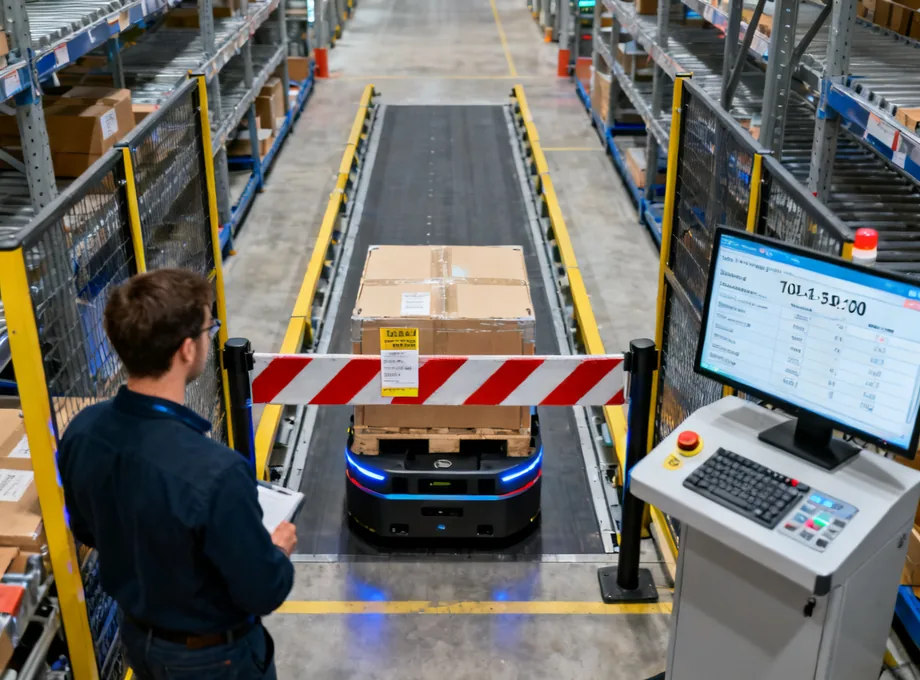
Exception recovery test for a blocked AMR destination
Scenario pattern / exception recovery

Measure the path back to controlled mission release

A throughput run under clean conditions cannot demonstrate how the fleet behaves when a destination is occupied, a load identity is missing or a confirmation arrives late. The script injects one defined condition, records which layer detects it and observes the action that clears or escalates it.

Recovery time is interpreted with the affected flow boundary. A robot-level replan, a zone closure and a facility-wide material-flow interruption are not equivalent events. Peak rate versus operational resilience is an explicit trade-off: buffers and redundant paths may lower a headline rate while protecting stable output during disturbances.

Trigger
Blocked path, message timeout or invalid identity
Observation
Alarm propagation, robot state and physical load position
Closeout
Authorized restart and downstream inventory confirmation
InputRevision, owner, unit
MethodScript, duration, condition
ResultObserved state and log
DispositionOwner, due date, approval
Service readiness brief

Define the recovery boundary before response language

Provide the installed or proposed fleet list, operating calendar, critical mission paths, local maintenance capability and allowed remote-access method. Add the longest tolerable interruption by zone and the evidence your team requires before restart.

Do not send passwords, system credentials or other sensitive personal data through the inquiry form. A secure exchange route can be agreed if detailed logs or drawings are needed.

  • Robot, zone and controls scope
  • Shift windows and maintenance access
  • Critical spares and mean time to repair assumptions
  • FAT/SAT open-item ownership

Request a SEER Robotics service review